Why Your Bedroom Setup Matters More Than You Think
Most people treat their bedroom as an afterthought — a place with a bed and a phone charger. But research shows your sleep environment has a bigger impact on sleep quality than almost any supplement or hack.
A 2012 study in the journal Sleep found that participants who optimized their bedroom environment fell asleep 50% faster and experienced 30% more deep sleep. The environment is not a nice-to-have — it is the foundation.
Temperature: The 65°F Rule
Your core body temperature needs to drop by 1-2 degrees Fahrenheit to initiate sleep. A room that is too warm interferes with this process.
Optimal range: 60-67°F (15-19°C). Most sleep researchers agree 65°F is the sweet spot for the average adult.
Practical tips:
- Use a programmable thermostat to drop temperature 30 minutes before bedtime
- Consider a bedside fan — the airflow helps with thermoregulation and provides white noise
- Use breathable cotton or bamboo sheets instead of synthetic materials
- Consider a cooling mattress pad if you sleep hot
Lighting: Eliminate All Light Sources
Even small amounts of light can suppress melatonin production by up to 50%. A 1999 study by Joshua Mohn found that light exposure as dim as a night light was enough to shift circadian rhythms.
Action steps:
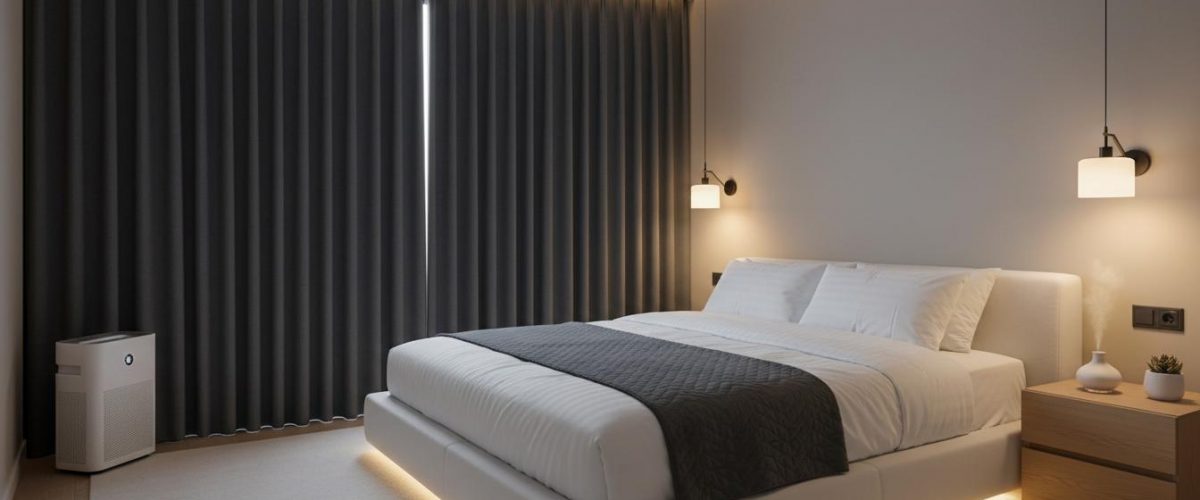
- Install blackout curtains — block 100% of external light
- Cover or remove all LED indicators (chargers, routers, smoke detectors — use electrical tape)
- Use a sleep mask as backup — the Alaska Bear silk mask is the gold standard
- Keep phones face-down or in another room
Noise Control: The Science of Silence (and White Noise)
Unexpected noises — a car door, a creaking floor — trigger micro-arousals that disrupt deep sleep without fully waking you. You wake up groggy without knowing why.
Two approaches work:
- Complete silence: Earplugs (foam or silicone) for noise blocking
- Consistent sound: White noise machines that mask intermittent sounds
The LectroFan Evo is the best-reviewed white noise machine with 20 non-looping sounds. It runs all night without the audio gaps that cheaper machines have.
Bedding: Your Sleep Surface Matters
You spend one-third of your life in bed. Invest accordingly.
Mattress: Medium-firm mattresses correlate with better sleep quality and less back pain according to a 2009 study in the Journal of Chiropractic Medicine. The Zinus Green Tea Memory Foam offers the best value under $300.
Pillows: Side sleepers need firm, high-loft pillows. Back sleepers need medium. Stomach sleepers need thin, soft pillows. The Coop Home Goods Eden Pillow is adjustable and works for all positions.
Sheets: Look for long-staple cotton (Pima or Egyptian) with a thread count between 300-500. Higher thread counts trap heat. The Brooklinen Luxe Core Sheet Set consistently tops best-of lists.
The 5-Point Sleep Sanctuary Checklist
- Temperature: Set thermostat to 65°F (18°C) 30 min before bed
- Light: Zero light sources — blackout curtains + tape over LEDs
- Noise: White noise machine or earplugs
- Bedding: Medium-firm mattress, position-appropriate pillow, breathable sheets
- Air quality: Consider a HEPA air purifier — the LEVOIT Core 300 is quiet enough for bedrooms
The One Mistake Everyone Makes
They optimize everything except the one thing that matters most: removing the phone.
Blue light is part of the problem, but the bigger issue is psychological stimulation. The infinite scroll of Instagram and the stress of email notifications keep your sympathetic nervous system activated — the exact opposite of what you need for sleep.
Solution: Charge your phone in another room. Use a dedicated alarm clock like the Philips SmartSleep Wake-Up Light. Your sleep will improve within 48 hours.
Final Thoughts
You do not need to implement everything at once. Start with temperature and light — those two changes alone will produce the biggest results. Add noise control next. Upgrade bedding when your budget allows.
The goal is not perfection. It is building a room that signals to your brain: when I am here, it is time to sleep.
The 5 Elements of a Sleep Sanctuary
Your bedroom should be a single-purpose space dedicated to sleep. Start with darkness: blackout curtains are non-negotiable if you live anywhere with streetlights, early sunrise, or neighbors who keep lights on. Even small amounts of light (5-10 lux) suppress melatonin production. Use blackout curtains, cover LED displays, and eliminate all light sources.
Temperature is next. The ideal sleep temperature is 60-67°F (15-19°C). Your core body temperature needs to drop 2-3 degrees to initiate sleep. Keep your room cool, use breathable bedding (cotton or linen), and consider a fan or air purifier for air circulation. Noise control: use a white noise machine to mask disruptive sounds, or earplugs if you prefer silence.
The Psychological Component
Your brain creates strong associations between environments and behaviors. If you work, eat, and watch TV in bed, your brain stops associating the bedroom with sleep. Reserve your bed for sleep and sex only. If you can’t fall asleep within 20 minutes, get up and do something relaxing in another room until you feel sleepy. This retrains your brain to associate the bedroom with rapid sleep onset.
Recommended Sleep Sanctuary Products
NICETOWN Thermal Insulated Blackout Curtains — Blocks 85-99% of outside light depending on color. Thermal insulated layer also reduces noise and maintains room temperature. Available in multiple sizes and colors. 4.6 stars from 212,000+ reviews. The #1 bestseller in blackout curtains.
Coway AP-1512HH Mighty Air Purifier — True HEPA filtration captures 99.97% of airborne particles — dust, pollen, pet dander, and mold spores. Quiet on low setting (24.4 dB) for bedroom use. Eco mode automatically adjusts fan speed based on air quality. 4.7 stars from 57,000+ reviews.
Gravity Weighted Blanket (15 lbs) — The original weighted blanket that launched the category. Engineered to be 7-10% of your body weight for optimal Deep Pressure Stimulation. Reduces anxiety and improves sleep onset. 4.5 stars from 19,000+ reviews.