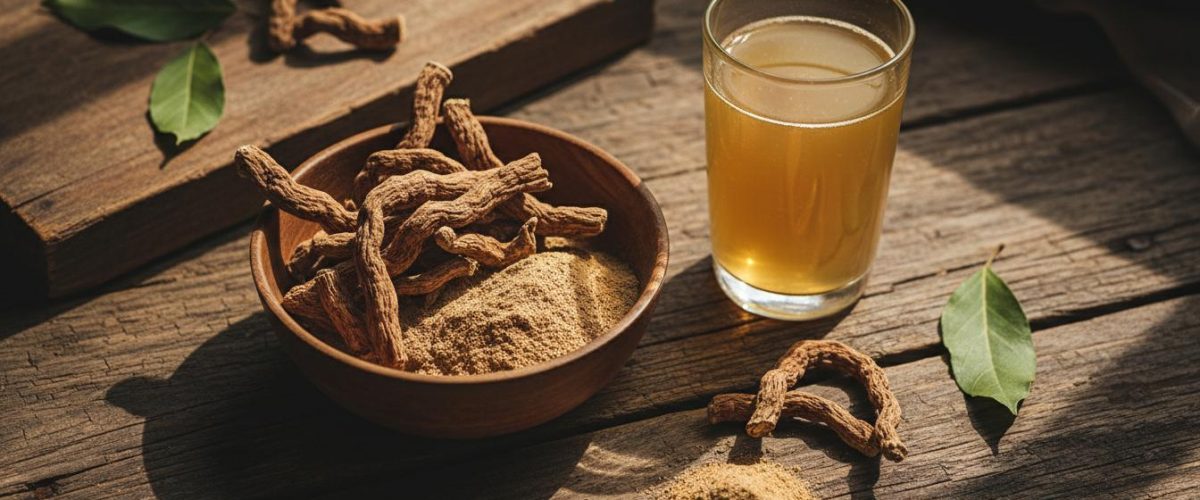
What Is Ashwagandha?
Ashwagandha (Withania somnifera) is an adaptogenic herb used in Ayurvedic medicine for over 3,000 years. The name translates to “smell of horse” — a reference to its odor and the traditional belief that it gives you the strength of a stallion.
Modern research has validated many of its traditional uses, particularly for stress reduction, anxiety, and sleep improvement. The active compounds — withanolides — modulate the hypothalamic-pituitary-adrenal (HPA) axis, your body’s central stress response system.
How Ashwagandha Works
Unlike sedatives that force your brain to slow down, ashwagandha works by reducing the signals that tell your brain to speed up. Specifically:
- Lowers cortisol: Multiple studies show 15-30% reductions in cortisol levels
- Modulates GABA receptors: Enhances the brain’s primary calming neurotransmitter
- Reduces inflammation: C-reactive protein (CRP) decreases by 30%+ in clinical trials
- Supports thyroid function: May improve T3 and T4 levels in subclinical hypothyroidism
The Research: What Studies Actually Show
Stress and Anxiety
A 2012 double-blind, randomized controlled trial found that 600mg of ashwagandha root extract daily for 60 days reduced cortisol by 27.9% and subjective stress scores by 44%.
A 2019 systematic review of 5 human trials concluded that ashwagandha “significantly outperformed placebo for anxiety outcomes.”
Sleep Improvement
A 2020 randomized controlled trial found that 300mg of ashwagandha twice daily improved sleep quality by 72% in subjects with insomnia. Sleep onset latency decreased by an average of 15 minutes.
The mechanism: by lowering cortisol — which naturally peaks in the evening and interferes with melatonin — ashwagandha removes one of the biggest biological barriers to sleep.
Physical Performance
Multiple studies show improvements in strength, muscle mass, and VO2 max. A 2015 study found that 600mg daily increased muscle strength by 14% and muscle mass by 3.5% over 8 weeks in untrained men.
Optimal Dosage and Timing
Standardized root extract (KSM-66 or Sensoril): 300-600mg daily
Timing: Split into two doses — morning and evening — or take entirely in the evening for sleep benefits
With food: Take with a meal containing fat (withanolides are fat-soluble)
Duration: Effects build over 2-4 weeks. Minimum 30-day trial before evaluating
KSM-66 vs. Sensoril: Which Extract?
Both are patented, clinically studied extracts:
- KSM-66: Full-spectrum extract (higher withanolide concentration). Best for stress, anxiety, and physical performance.
- Sensoril: Higher concentration of specific withanolides. Best for sleep and cognitive function.
For sleep specifically, Sensoril may have a slight edge. For general stress, either works well.
Best Ashwagandha Supplements
Best overall: Nootropics Depot KSM-66 Capsules — third-party tested, standardized to 5% withanolides, excellent reputation for purity.
Best for sleep: Pure Encapsulations Ashwagandha (Sensoril) — hypoallergenic, clinical-grade, best for evening use.
Best budget: NOW Foods Ashwagandha 450mg — reliable brand, good value, standardized extract.
Side Effects and Safety
Common side effects: Mild drowsiness (especially at higher doses), stomach upset if taken without food.
Contraindications:
- Autoimmune conditions: Ashwagandha stimulates immune function — avoid in lupus, MS, RA, Hashimoto’s
- Thyroid disorders: May increase thyroid hormone levels — monitor if on thyroid medication
- Pregnancy/breastfeeding: Traditional abortifacient — avoid
- Surgery: Stop 2 weeks before surgery (sedative effects may interact with anesthesia)
Drug interactions: Sedatives (benzodiazepines, Ambien), thyroid medication, immunosuppressants. Consult your doctor if taking any of these.
How to Tell If It Is Working
After 2-4 weeks of consistent use:
- Stress feels more manageable (situations that used to trigger anxiety feel neutral)
- Falling asleep is easier (racing thoughts subside faster)
- Morning grogginess decreases
- Recovery from exercise improves
- General sense of calm without sedation
If you do not notice any of these after 30 days, ashwagandha may not be the right adaptogen for your biology.
Stacking with Other Supplements
Ashwagandha pairs well with:
- Magnesium glycinate: Synergistic calming effect, both support GABA
- L-theanine: Daytime calm without drowsiness (take ashwagandha evening, L-theanine morning)
- Melatonin: For severe insomnia — ashwagandha addresses cortisol, melatonin addresses timing
Avoid combining with other sedatives without medical supervision.
Final Verdict
Ashwagandha is one of the most well-researched, effective natural supplements for stress and sleep. It is not a sedative — it removes the biological signals (cortisol, inflammation) that keep you wired.
Take 300-600mg of a standardized extract (KSM-66 or Sensoril), split morning and evening. Give it 30 days. Track your stress levels, sleep quality, and recovery. Most people notice a significant difference.
As with all supplements, quality matters. Cheap, non-standardized ashwagandha may contain minimal active compounds. Invest in a reputable brand with third-party testing.
How Ashwagandha Reduces Cortisol
Ashwagandha is an adaptogen — a class of herbs that help your body adapt to stress. The active compounds, called withanolides, work by modulating the hypothalamic-pituitary-adrenal (HPA) axis, your body’s central stress response system. When stress hits, your HPA axis triggers cortisol release. Chronic activation leads to anxiety, poor sleep, and burnout.
A landmark 2019 randomized controlled trial published in Medicine found that 300mg of KSM-66 ashwagandha twice daily reduced serum cortisol by 30% over 8 weeks. Participants also reported significant improvements in sleep quality, stress resilience, and overall well-being compared to placebo.
Ashwagandha for Sleep: The Timing Matters
For stress and anxiety: take 300mg in the morning and 300mg in the afternoon. For sleep specifically: take 600mg 30-60 minutes before bed. The sedative effects build over time — most people notice improved sleep within 1-2 weeks of consistent use. Ashwagandha is generally well-tolerated but should be cycled (8 weeks on, 2 weeks off) to maintain effectiveness.
Recommended Ashwagandha Products
Nootropics Depot KSM-66 Ashwagandha Extract (300mg) — The most clinically studied form of ashwagandha. KSM-66 is a full-spectrum root extract backed by 24+ human clinical trials. 300mg per capsule, the research-standardized dose. Third-party tested for purity. 4.5 stars from 6,700+ reviews.
Organic India Ashwagandha Capsules — USDA Certified Organic, non-GMO ashwagandha root powder. 400mg per capsule. A gentler, more traditional formulation ideal for beginners. 4.4 stars from 18,000+ reviews.