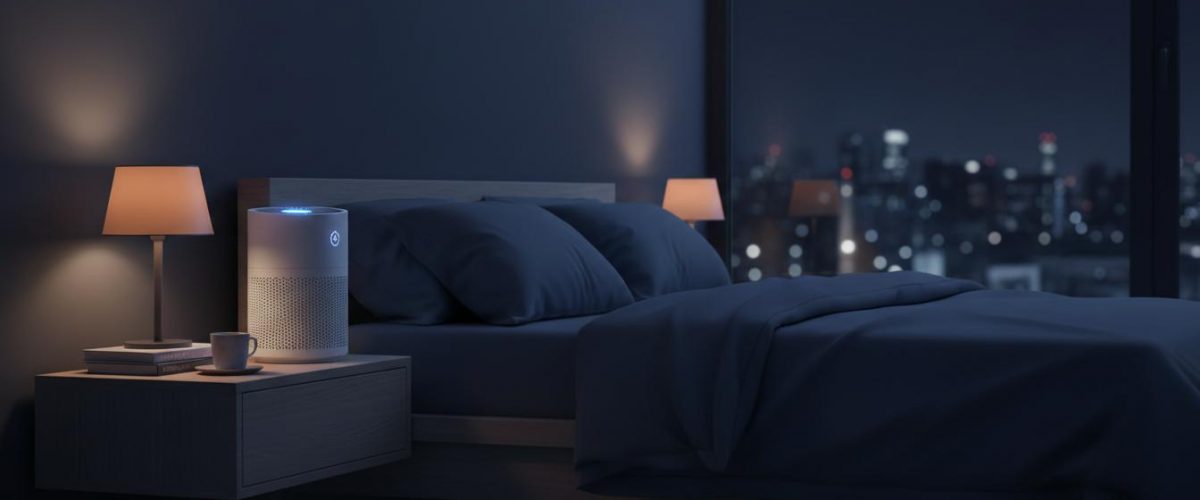
Why Air Quality Matters for Sleep
You can have the perfect mattress, the best blackout curtains, and a rock-solid bedtime routine — but if the air in your bedroom is full of allergens, dust, and VOCs, your sleep quality will suffer. Poor indoor air quality is linked to increased sleep-disordered breathing, nighttime allergies, and morning grogginess.
What the Research Says
Studies show that bedroom particulate matter (PM2.5) and elevated CO2 levels significantly reduce deep sleep stages. Allergens like dust mites, pet dander, and pollen trigger nasal congestion, forcing mouth breathing — which increases snoring and sleep fragmentation.
What to Look for in a Sleep-Focused Air Purifier
1. True HEPA Filtration
Look for H13 or H14 grade HEPA filters that capture 99.97% of particles down to 0.3 microns. This is the gold standard for removing airborne allergens from your sleep environment.
2. Quiet Operation (Under 30 dB)
Sleep mode should keep noise levels below 30 decibels — roughly the sound of a whisper. Anything louder becomes its own sleep disruptor.
3. Activated Carbon Layer
HEPA handles particles, but activated carbon adsorbs gases, VOCs, and odors from cleaning products, off-gassing furniture, and outdoor pollution that seeps in.
4. Proper Room Coverage
Measure your bedroom. You need an air purifier rated for your room size with at least 2-3 air changes per hour (ACH). Undersized units run on high (noisy) and still don’t clean effectively.
5. No UV-C or Ionizer Nonsense
UV-C lights and ionizers are marketing gimmicks that produce ozone — a lung irritant that worsens respiratory issues. Stick to mechanical filtration only.
Top Picks for 2026
Best Overall: IQAir HealthPro Plus
The HyperHEPA filter captures particles 100x smaller than standard HEPA. Swiss-built, independently tested, and whisper-quiet in sleep mode. It’s expensive, but if you have allergies or asthma, it’s the gold standard. Check price at IQAir →
Best for Large Bedrooms: Austin Air HealthMate Plus
15 pounds of activated carbon and zeolite plus medical-grade HEPA. Handles VOCs, formaldehyde, and chemicals better than anything else. Best for new homes, recent renovations, or high-pollution areas. Check price at Austin Air →
Best Budget Option: Coway Airmega AP-1512HH
Independent testing consistently ranks the Coway among the best for particle removal. Eco mode automatically adjusts based on air quality, and it’s quiet enough for most sleepers. The filter replacements are affordable too. Check price on Amazon →
Best Smart Purifier: Mila Air Purifier
App-controlled with granular data on your air quality. The “Sleep Angel” filter pack is specifically designed for bedrooms — extra carbon for VOCs and a quieter fan profile. Check price at Mila →
Best for Travel: Pure Enrichment PureZone Mini
Hotel rooms are notorious for poor air quality. This portable HEPA purifier fits in your luggage and handles small spaces up to 100 sq ft. Perfect for business travelers. Check price on Amazon →
Placement Tips for Maximum Effectiveness
- Position 6-10 feet from your bed — close enough for clean air circulation, far enough to avoid direct draft.
- Keep it elevated — on a nightstand or small table. Air purifiers work best when not on the floor.
- Don’t block intake or output — maintain 1-2 feet of clearance on all sides.
- Run it on high before bed — an hour of high speed cleans the room, then switch to sleep mode.
- Keep bedroom door closed — this creates a contained environment the purifier can actually manage.
The Bottom Line
An air purifier won’t fix bad sleep hygiene, but it removes a significant environmental variable working against you. If you wake up congested, allergy-prone, or suspect your bedroom air quality, a HEPA purifier is one of the highest-ROI sleep upgrades you can make.