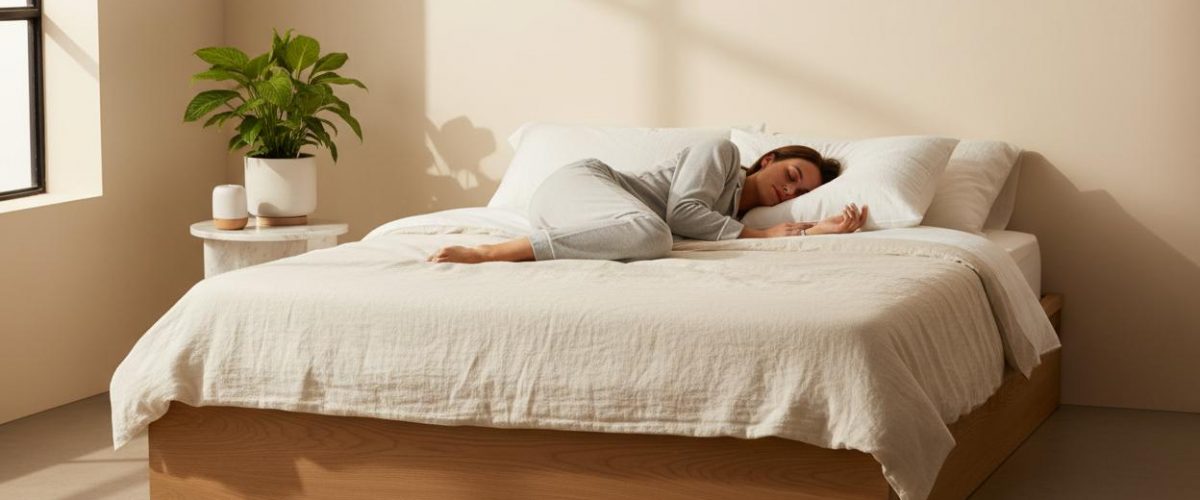
Your Sleep Position Is Either Healing or Hurting Your Spine
How you sleep affects your spinal alignment for roughly one-third of your life. A position that twists or overextends your spine creates micro-trauma that accumulates into chronic pain. The right position allows your spine to rest in its natural curvature, reducing inflammation and promoting tissue repair.
The research is clear: sleep position significantly affects spinal mechanics. Subjects who slept in their optimal position reported 40% less morning pain and stiffness compared to their habitual position.
Side Sleeping: Best for Most People
Side sleeping is the most common and generally the healthiest position — provided you do it correctly. It maintains the natural S-curve of the spine and reduces snoring and sleep apnea symptoms.
Optimal Side Sleeping Setup
- Pillow height: Thick enough to fill the space between your shoulder and head, keeping your neck neutral. Your ear should align with your shoulder, not drop toward or lift away from it.
- Between-knee pillow: Essential. Without it, your top leg rotates your pelvis, twisting the lower spine. A contoured knee pillow maintains hip alignment.
- Hug pillow: Prevents shoulder collapse and maintains upper spine alignment.
Best Side: Left vs. Right
Left side sleeping has marginal benefits: it reduces acid reflux (keeps the stomach below the esophagus) and may improve lymphatic drainage. Right side sleeping is fine too — the difference is minor. Choose whichever side is more comfortable for your shoulder.
Back Sleeping: Best for Spinal Health
Back sleeping distributes weight evenly across the widest surface area, minimizing pressure points and maintaining neutral spinal alignment. It’s the gold standard — if you can do it comfortably.
Optimal Back Sleeping Setup
- Pillow height: Thin to medium. Your head should rest level — not tilted forward or backward. A cervical pillow with a neck roll maintains the natural cervical curve.
- Knee elevation: Place a pillow under your knees to reduce lumbar strain. This flattens the lower back against the mattress, reducing the natural lordotic curve that can cause morning lower back pain.
- Shoulder positioning: Let your arms rest at your sides or on your stomach. Avoid raising them above your head, which compresses the shoulder nerves.
Stomach Sleeping: Avoid If Possible
Stomach sleeping forces your neck into extreme rotation (you have to turn your head to breathe) and flattens the natural cervical curve. It’s the worst position for spinal health and the hardest on your neck.
If you absolutely can’t sleep any other way:
- Use the thinnest pillow possible — or no pillow at all
- Place a pillow under your hips to reduce lumbar extension
- Alternate which direction you turn your head each night
- Consider training yourself out of it — stomach sleeping is a habit, not a preference
Position-Specific Pain Solutions
Lower Back Pain
- Side sleepers: Firm mattress + between-knee pillow. The pillow prevents pelvic rotation.
- Back sleepers: Pillow under knees. Reduces lumbar lordosis.
- All positions: Medium-firm mattress. Too soft = spine sags. Too firm = pressure points.
Neck Pain
- Side sleepers: Contoured cervical pillow that fills the neck gap. Tempur-Pedic neck pillow is the clinical standard.
- Back sleepers: Low-loft pillow with neck support. Memory foam conforms to cervical curvature.
- Avoid: Stomach sleeping. Full stop.
Sciatica and Hip Pain
- Side sleep with painful side up — reduces pressure on the affected nerve
- Between-knee pillow is non-negotiable — hip rotation compresses the sciatic nerve
- Fetal position: Gently curled on your side with knees drawn up. Opens the facet joints and reduces nerve root compression.
Shoulder Pain
- Sleep on the unaffected side — pressure on a painful shoulder worsens inflammation
- Hug a body pillow — prevents the upper shoulder from rolling forward and compressing the joint
- Back sleeping: Best option if both shoulders are affected
Training Yourself to Change Positions
If your habitual position is causing pain, you can retrain yourself:
- Set up barriers: Tennis balls sewn into a t-shirt pocket on your back prevent stomach sleeping
- Use positional pillows: Body pillows make side sleeping more comfortable and natural
- Tape a reminder: A small piece of tape on your hand serves as a bedtime cue to start in the correct position
- Be patient: Position changes take 2-4 weeks to become automatic
The Bottom Line
Side sleeping with proper pillow support works for most people. Back sleeping is ideal if you can manage it. Stomach sleeping should be eliminated if you have any spinal issues. The right position combined with the right pillow and mattress is often more effective than pain medication for chronic morning back and neck pain.